


Warenkorb
Tickets kaufen
Workshop für Schulen
Scratch meets AI
Face Sensing & Large Language Models
Scratch meets AI
In our AI with Scratch workshop, students explore how methods from computer science, mathematics, and art can be meaningfully combined. From probabilities and prompt design in large language models to distances and coordinates in face sensing—always embedded in the context of art appreciation at the museum. Using webcams and sample data, the screen becomes a space for experimentation, and the students’ own creations respond to their presence.
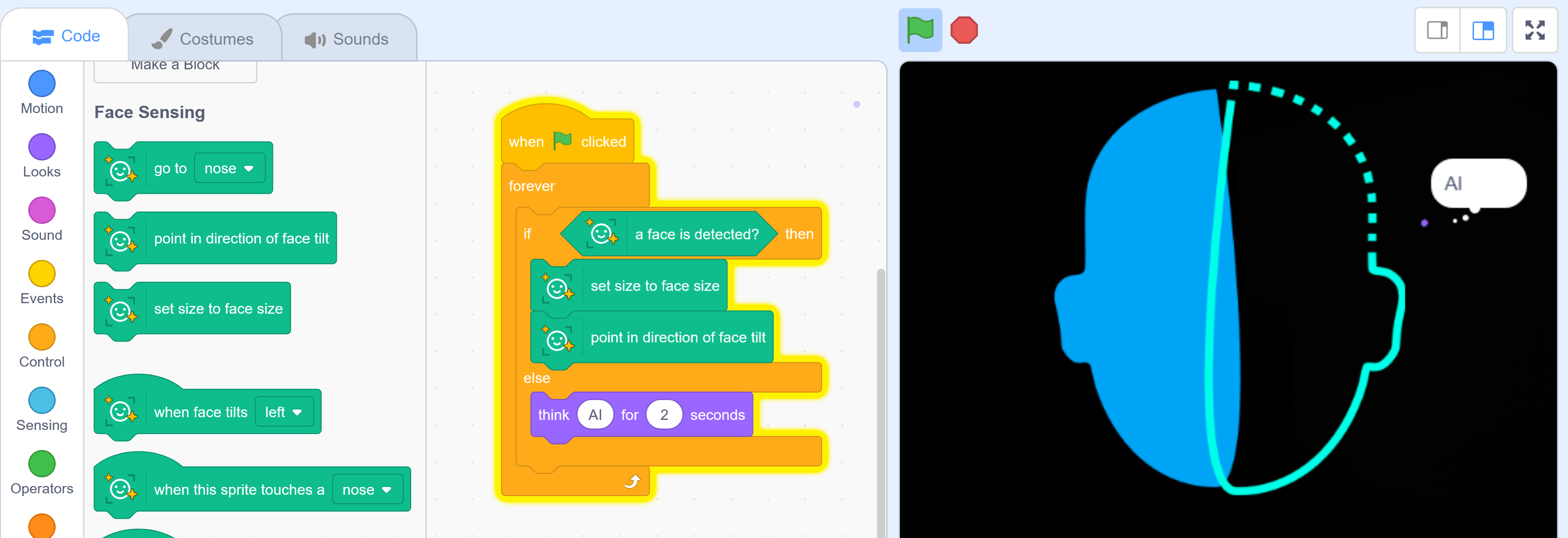
Students train a small text classifier (based on language model principles) and program a face sensing project that translates movement into image, color, or sound. The Scratch projects are age-appropriate and linked to artworks in the exhibition—bridging analog experience and artificial intelligence. Team-building included!
Scratch meets AI – Face Sensing & Large Language Models
Understanding & shaping AI – playfully and critically
In this workshop, we combine art observation, coding, and data literacy. The class explores how large language models (LLMs) work with probabilities and why well-crafted prompts matter. In parallel, students learn how computers recognize faces—using coordinates, point clouds, and distances in images. In Scratch, teams implement their insights directly: from a self-trained mini classifier to an interactive face sensing project.
Why this workshop?
Because students learn not just to consume technology, but to understand, evaluate, and actively shape it. In times of AI, automation, and misinformation, the workshop sharpens awareness of data, models, probabilities, and limitations (keywords: black box, bias, hallucinations). Learners break down phenomena into clear steps (algorithmics), make informed decisions (prompt design, parameters), collaborate, and give structured feedback. This fosters key future skills—genuine empowerment from “I can’t do this” to “I built this.”
Structure
- Guided Introduction: What is AI? A brief overview of LLMs (tokens, prompts, input/output, black box) & face sensing (features, landmarks, coordinate systems)
- Team Work: Students work in pairs, run short test loops, and share results
- Module A – Large Language Models (Scratch Classifier)
Students train a small language model/classifier. Goal: understand that LLMs calculate word probabilities rather than “meaning” as humans do. Practice prompt rules (clarity, context, examples) - Module B – Face Sensing
How does a computer recognize a face? Using pixel coordinates, landmarks, and distances (math in coordinate systems). Implementation as interactive Scratch project (e.g., facial expressions trigger sound/image) - We use royalty-free/Creative Commons media so students can start right away
Curriculum Links
- Digital Literacy, Computer Science, Math (coordinate systems/geometry)
- Visual Arts/Media Education (STEAM)
Equipment
- Laptops/computers with internet & browser access to Scratch (mouse/trackpad recommended)
- For face sensing: webcam or prepared sample images (no data storage)
- Equipment provided by mumok; own devices possible upon request
Duration & Location
- 2 hours at mumok
- Meeting point: Main entrance (top right after the staircase)
Good to Know
We tailor the pace and depth to the learning group (from beginner to advanced). Projects work best with a mouse or trackpad; tablets are possible if a keyboard is available.
Request a Date
Explore AI critically, learn to code, and think creatively – we’re happy to support you in planning and defining learning goals for your class.
© mumok – museum moderner kunst stiftung ludwig wien